



Total international visitor arrivals to the USA reached 68.3 million year-to-date (YTD) through December 2025. This number is down 5.5% compared to 2024 and represented 86% of pre-pandemic 2019 levels. The recovery, while ongoing, remains uneven across key markets.
Overseas arrivals totaled 34.3 million, a modest decline of 2.5% year-over-year, indicating relatively stronger resilience compared to nearby markets. Notably, three regions posted gains in visitor volumes. Central America led growth with a 4.7% increase to 1.69 million visitors, followed by Eastern Europe (+2.5%) and the Middle East (+2.0%), each contributing just over 1.1 million travelers.
In the meantime, hostile political statements and positions of the current Trump administration against some countries influenced negatively travel to the USA. As an example, Danish arrivals to the USA were down by 23.5% while Swiss arrivals declined by 10.7%.
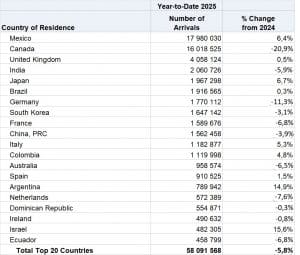
Mexico retained its position as the top inbound market, delivering nearly 18 million visitors, up 6.4% from 2024. In contrast, Canada, the second-largest source market, saw a sharp 20.9% decline to 16 million visitors, weighing heavily on overall performance. By gateway, New York remained the leading port of entry with 5.8 million arrivals, followed by Miami and Los Angeles.
Outbound travel by U.S. citizens painted a more robust picture. December departures rose 3.6% year-over-year to 10.2 million, exceeding pre-pandemic levels by 15%. For the full year, North America accounted for 48.6% of outbound travel, while overseas destinations captured a slightly higher 51.4% share.
Mexico dominated outbound flows with over 39.6 million trips YTD, while the Caribbean attracted 11.3 million travelers, together representing nearly half of all departures. Europe ranked as the second-largest overseas destination in December, with 1.59 million U.S. visitors, up 2.9% from the previous year, underscoring sustained transatlantic demand.

 DOLAR
DOLAR EURO
EURO İNG. STERLİNİ
 İSV. FRANGI
 KAN. DOLARI
 ÇEYREK ALTIN
 BITCOIN