


The reopening of operations is also expected to ease pressure on governments attempting to repatriate citizens. The United Kingdom’s Foreign Office, for example, has struggled to coordinate delayed rescue flights from neighbouring Oman as travellers remained stuck in transit.
Emirates announced that by Saturday it plans to restore 11 daily flights to five British airports and operate around 60 percent of its global network, serving 83 destinations. These include seven airports in the United States and a total of 22 daily flights to India. However, even a partial return of services may not fully reassure travellers who spent the past week questioning how global travel would function without the Gulf’s key aviation hubs.
Before the crisis, the region’s three major aviation centres — Dubai, Abu Dhabi and Doha — had become the crossroads of global air travel. Airlines based there built vast networks linking Asia, Africa and Europe while also connecting passengers to the Americas and Oceania.
Every day nearly 300,000 travellers pass through one of these hubs, and about two-thirds are transit passengers connecting to another flight. The closure of Russian and Ukrainian airspace following Russia’s invasion of Ukraine had already pushed many eastbound routes south toward the Gulf corridor, making it the fastest and often cheapest route for travellers moving between continents.
When US-Israeli strikes on Iran began and retaliatory rockets and drones forced the closure of Gulf airports, disruptions quickly spread worldwide. Flights were cancelled or rerouted across continents, leaving many travellers stranded mid-journey.
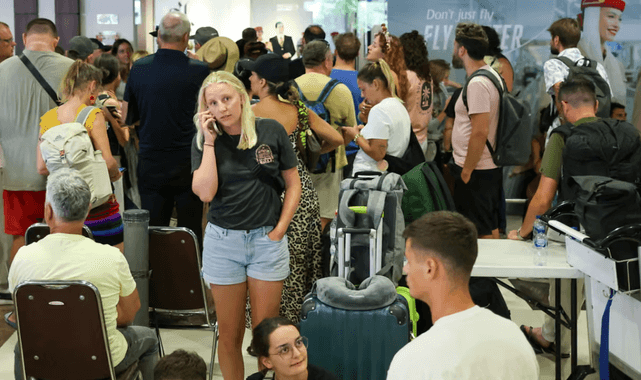
While those directly affected by the conflict face far greater hardships, thousands of passengers found themselves unexpectedly trapped in transit. Travellers on what should have been short stopovers suddenly faced extended stays in airport lounges or foreign hotels as flights were suspended.
The scale of passenger traffic through the Gulf hubs meant that even a few days of disruption created a massive backlog. Governments around the world were hoping for the resumption of operations by Gulf airlines as the most practical way to bring citizens home.
With UAE airspace only partially restricted, Etihad Airways followed Emirates in restarting limited services, mainly for repatriation flights. However, Qatar’s airspace remains fully closed.
According to aviation analyst John Grant, about 70 percent of the 55,000 passengers who pass through Abu Dhabi’s Zayed International Airport on a typical day are transit travellers. Dubai’s airport handles around 175,000 passengers daily, with roughly 55 percent connecting onward to other destinations.
Experts warn that prolonged disruption could reshape global travel patterns. Aviation analyst Andrew Charlton suggests that if instability continues, passengers may begin choosing alternative routes and destinations.
Tourism in the region could also take a significant hit. Economic consultancy Oxford Economics estimates that even a short conflict could lead to an 11 percent drop in visitors to the Middle East this year, representing roughly $34 billion in lost spending.
Yet replacing the Gulf transit system may not be easy. On routes such as Australia to the United Kingdom, the number of flights operating via Gulf hubs far exceeds alternatives offered by other airlines in Asia.
Geography has been a key factor behind the Gulf’s aviation dominance. Around two-thirds of the world’s population lives within an eight-hour flight of the region. While ultra-long-haul flights are technically possible, they are far less fuel-efficient beyond certain distances.
The region’s airlines have also played a central role in the rise of Gulf cities as global economic and political players. Massive investments in aircraft fleets, airports and international branding have helped build powerful global aviation networks.
For example, Emirates has made extensive use of the Airbus A380 superjumbo, the largest passenger aircraft ever built, using its capacity to transport huge numbers of passengers while offering luxury amenities such as onboard shower spas in first class.
Despite current disruptions, industry leaders believe the long-term growth of Gulf aviation will continue. Emirates president Tim Clark recently noted that the airline’s profits have risen dramatically in the years since the Covid-19 pandemic.
However, the ongoing conflict could have wider consequences for the aviation industry. Oil prices have surged following disruptions to shipping through the Strait of Hormuz, a route responsible for around 20 percent of global oil flows.
Brent crude prices climbed above $90 per barrel on Friday, compared with roughly $72.50 before the conflict began. Rising fuel prices pose a major challenge for airlines, where fuel can account for about a quarter of operating costs.
Credit rating agencies are monitoring the situation closely, warning that prolonged instability could lead to downgrades for several airlines if fuel prices remain high and travel demand shifts.
For passengers, the likely result is higher ticket prices. Airlines often pass rising fuel costs on to customers, and reduced flight capacity through the Middle East could further push up long-haul fares.
If disruptions continue, some alternative hubs could benefit. Analysts suggest that Istanbul and several African carriers may gain more transit traffic as airlines seek new routes linking Europe, Asia and Africa.
Still, many experts believe the Gulf airlines will eventually recover their dominant position. As Andrew Charlton notes, carriers such as Emirates have historically regained market share quickly by offering competitive fares before gradually raising prices once demand returns.
Source: The Guardian
